I give lectures on a wide variety of subjects that are of special interest to me. All are on powerpoint and last approximately one hour though times can be varied.
1. Doctoring –A very fine art
Artists have depicted multiple aspects of medicine and its practice for centuries. Often their perceptions are tempered by personal experience of sickness or chronic ill health.
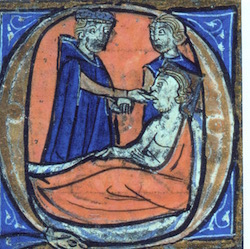
This lecture looks at how artists as diverse as Jan Steen, Rene Magritte and L. S. Lowry have depicted the various steps in the development of modern doctoring.
It is a profession that grew out of superstition and quackery before the birth of modern scientific medicine in the 19th century. The various stages in a doctor’s life from student to senior clinician are explored with insight and humour.
The talk highlights the importance of the doctor-patient relationship in the life of a successful doctor.
2. Pox and Pestilence- Art and the unforgiving

Disease and how it is perceived and depicted by artists can tell us something very fundamental about what it is to be human. It tells us how we respond to the fear of the unknown, of disability and death.
It also tells us about the fundamental human need to believe in something greater than oneself as a source of comfort and support.
This lecture explores how artists have tackled these difficult themes in relation to epidemic infectious diseases such as leprosy, smallpox, AIDS and Ebola! It recognises how artists can remain remarkably positive amidst suffering. All is not doom and gloom!
3. The Plague-Art and the ultimate calamity

This lecture covers seven hundred years of art history related to the plague from the Middle Ages to the 20th century.
It illustrates how artists such as Tintoretto, Raphael and Titian, amongst many others, reflected in their art the wide range of human response to the devastating affect that plague had on individuals and communities.
Though the plague had devastating effects the talk illustrates the triumph of the human spirit in the face of great adversity.
4. Doctor what is wrong with me? – The art of diagnosis
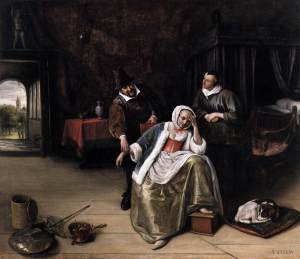
“What is wrong with me?” is the most common question put to any doctor. The ability of doctors to respond meaningfully has progressed in the last two thousand years from mythology and the four humors to endoscopy and MRI scans. This lecture illustrates how artists as varied as Ghirlandio, Holbein and Barbara Hepworth have depicted this diagnostic journey. Through their ability to record faithfully many different pathologies and procedures in their art they allow the modern observer to understand better a complex process that we now take for granted.
5. Medical Gold- From ancient Egypt to the Nobel Prize
From earliest times man has linked the lustre of gold with the warm, life giving light of the sun.
This lecture illustrates four thousand years of the history of gold in medicine. The ancient Egyptians used it for its magico-religious properties. Mediaeval alchemists strived to produce it as a source of eternal youth. Today it is a substance used in medical instrumentation, investigation and cutting edge therapies.
This talk illustrates how artists such as Rogier Van Der Weyden, Joseph Wright and Gustav Klimt, as well as numerous goldsmiths and instrument makers, have defined medicine’s relationship with the most coveted of all the elements. The lecture ends by describing how the ultimate “medical gold”, the Nobel Prize, has acknowledged some of the most fundamental advances in medical science.
6. Artists, Illness and Creativity

It is well known that both physical and psychological illness can affect the creative process.
Both can act as a stimulus but illness can also act as a major modifying influence on an artist’s perception of the world and on an artist’s creative output.
This lecture seeks to explore this relationship in artists such as Durer, Goya, Monet and Kahlo in an endeavour to understand better how different illnesses impacted on their genius.
7. The Art of Quackery-the very worst cures for nearly everything!
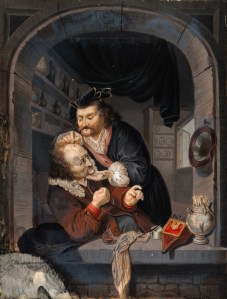 For every ache and pain, for every ailment known to man the quack has tried to sell his wares. Indeed he has sold the worst cures for nearly everything! For centuries right up to the present day artists have depicted the snake oil salesman and the pseudo science on which his cures are based. I shall take you on an amusing and fascinating journey amongst the sick, the not so sick and the gullible. Beware however this is not a source of actual medical advice!
8. The Art of Pandemics
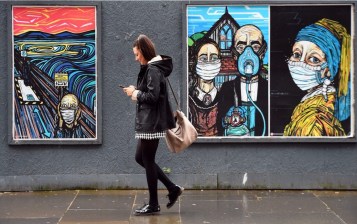 Many artists through the centuries have recorded the dramatic changes caused by pandemics. They have often done so by portraying fascinating individual and collective histories as well as producing wonderful devotional works of art. Such art can provide deep consolation and inspiration
Human nature does not change with the centuries. The need for explanation, treatment and consolation are universal and constant. Such needs are constantly reflected in pandemic art.
This lecture looks at some of the similarities and differences between the extensive art of the plague and the outpouring of street art that our own pandemic has inspired. Though separated by centuries there are some remarkable similarities!
Art and Medicine Study Day
It is a pleasure to give art and medicine study days when lectures are chosen from the list provided by arrangement. These lectures are supplemented with an exhibition and talk on a wide selection of antique medical instruments and artefacts from my own collection.
Bookings and Fees
Fees by arrangement. Please contact me to discuss your requirements.
Acknowledgements
I would like to thank the Wellcome Library and the Royal College of Physicians of London for permission to use images.
 Dr James Grant MBE